
Scotland by Public Transport vs Car: Which Is Better for Your Trip?
This post may contain affiliate / compensated links. As an Amazon Associate, I also earn from qualifying purchases at no extra cost to you. For full information, please see my disclaimer here. Thank you!
Wondering whether to rent a car or use public transport in Scotland? This is a common question in my Facebook group for people planning their trips, so I’ve put together a quick comparison to help you decide.
The short answer is that renting a car does give you more flexibility to explore, but Scotland’s public transport system is surprisingly extensive. You’re not limited to cites! I’ve managed to reach remote places without a car, like Corrour, which is only accessible on foot or by train.
As a car-free traveller, I can safely say that you’re not missing out if you decide not to drive, but realistically, it does have some limitations to consider. If you’re a large group or family and want to get off the beaten track or see more places in a day, I recommend renting a car.

If you’re a solo traveller, a couple or nervous about driving but still want to have plenty of adventures beyond the cities, public transport and a few well-chosen tours are your best fit. Read on to find out more about costs, limitations and alternative travel options to help you work out whether to explore Scotland by public transport vs car.
Psst…not in my private Facebook group? It’s free to join! Come and hang out with a friendly bunch of 13.2k+ members all planning their trips to Scotland. Check it out here.
Car vs public transport in Scotland: quick comparison
So, which option is right for you? Here’s a quick table to help you compare them at a glance.
Factors to consider | Public transport | Car rental |
Cost: | Tickets are per person with adult and child options available, plus passes | Rental prices are a flat fee per day which can be split between the group, plus cost of petrol and parking |
Flexibility: | Medium level with the right ticket but dependent on routes and timetables | Very flexible |
Planning required: | Medium amount | Low once hired |
Ease: | Yes when you keep routes simple and plan in advance | Yes, but bearing in mind unfamiliar roads, single-track roads, passing places and LEZ |
Best for: | Solo travellers, couples, slow travellers, first-timers, nervous drivers, scenic train lovers | Families, large groups and those who want to take lots of luggage, those who want more flexibility |
Worst for: | Large families and groups, those who want complete freedom and to reach remote places | Those who want to sit back and enjoy the view, solo travellers, city-based itineraries |
When public transport is the better choice
One of the biggest worries I hear is that visitors will miss the ‘real Scotland’ without a car. You’d be surprised at how many places you can see using trains, coaches and the occasional tour.
If you feel nervous at the thought of driving on unfamiliar roads, let me be the first to reassure you that you don’t need to rent a car to get around.

Scotland by public transport is the better choice for you if…
✔️ You don’t want to drive on single-track roads or think about parking, you don’t feel confident driving in new places, you don’t want to worry about insurance, and you don’t want to always be switched on for your whole trip.
✔️ It’s your first trip to Scotland. You can see many of the highlights, like Glencoe, Loch Ness, Oban, Skye and Glenfinnan without a car using a combination of public transport and small group tours.
✔️ You’re staying in cities. I don’t recommend driving in Edinburgh and Glasgow. Not only are you dealing with traffic, but you also have high parking fees and Low Emission Zones (LEZ) to navigate. Public transport in both cities is excellent and a lot less stressful. Plus, you can do day trips to places like Pitlochry or North Berwick from Edinburgh and the Isle of Arran or Loch Lomond from Glasgow.
✔️ You’re a solo traveller or a couple. It’s much cheaper to use public transport than to hire a car and pay for petrol.
✔️ You’re travelling light with a backpack and a medium-sized wheeled suitcase. Coaches have restrictions on the number of bags you can bring, and space on trains is limited. It’s best to stay as portable as possible!
✔️ You want to travel slowly, whether it’s a scenic train journey through the Highlands or taking the bus around the island. It’s perfect for you if you want to always be the passenger, watch the landscape change outside your window and relax into the journey. It’s also the more eco-friendly option, so you can get those green points.
If you’re leaning towards public transport but aren’t sure how to turn that into an actual itinerary, my Scotland Without a Car pocket guide walks you through exactly how to put together a route, how to save money and what to do when things go wrong. Click here to find out more.
When hiring a car is worth it
Public transport in Scotland does still have its limitations, which is where hiring a car might be better for your trip.
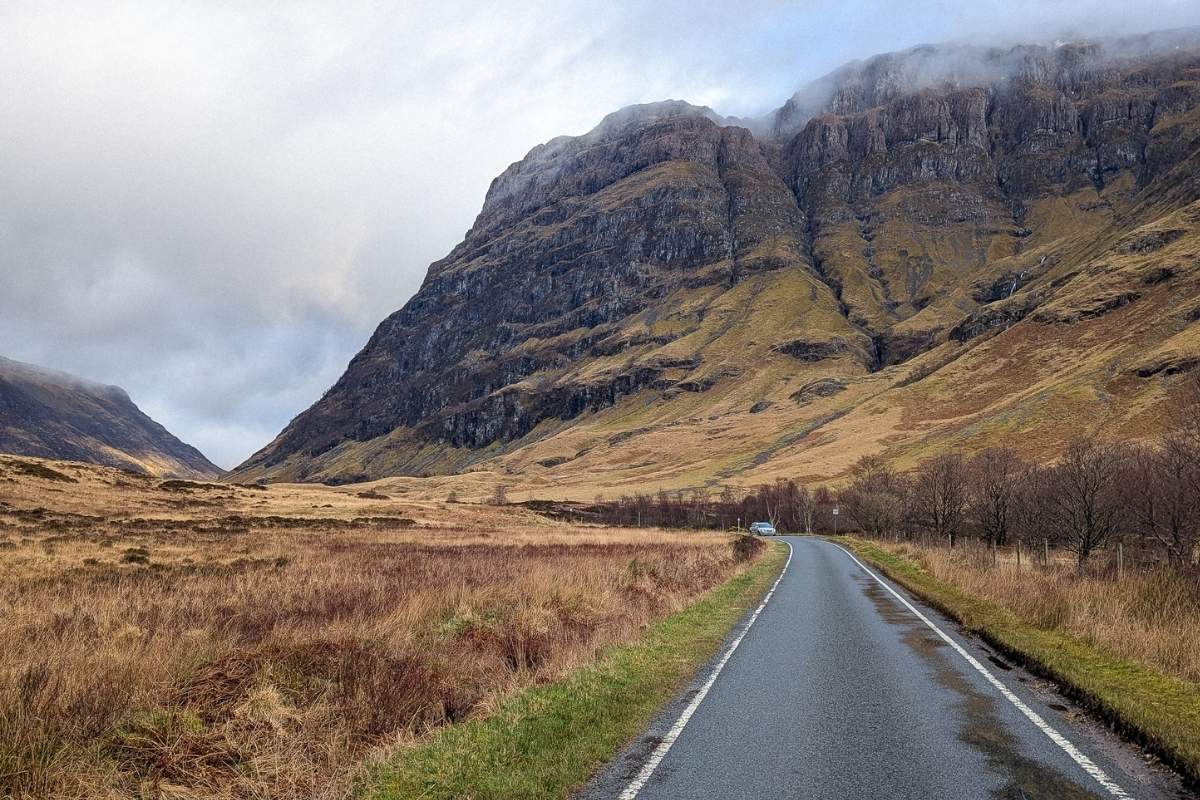
A car would be worth it for you if…
✔️ You want to be more flexible and ‘go with the flow.’ Renting a car gives you more time freedom as you’re not bound by schedules and timetables. Driving can also get you to your destination quicker than public transport, so it’s ideal if you’re short on time.
✔️ You want to reach more remote places. It’s much easier to get off the beaten track with a car, as areas like the Northern Highlands have little to no public transport. Other popular but remote routes like the North Coast 500 are also not accessible without a car (or bike).
✔️ You’re a family or group with lots of luggage. Negotiating public transport with luggage is difficult. While there is space, it’s very limited, and there are restrictions on the amount you can bring. With a car, you don’t have to worry about squeezing a bag into a full compartment or finding luggage storage at a station.
✔️ You would like to visit multiple places in a day. Public transport works best when you keep the number of places you visit to a minimum, while a car gives you the freedom to drive from one place to the next much more easily.
If you plan to rent a car, I highly recommend you give yourself a few days to recover from your journey to Scotland rather than jumping in a vehicle as soon as you arrive. Accidents happen when you’re tired, and an unfortunate number of tourists get caught out every year.
Car vs public transport in Scotland: which is cheapest?

The better value is highly dependent on your trip, group size, where you’re going and how much travel you’re planning to do, so it’s tricky to compare like with like.
I’ve put together a few basic costs to consider in the table below. Prices vary depending on season and route, so treat these as a starting point rather than fixed costs.
Costs to consider | Public transport | Car rentals |
Main transport: | Train/bus/coach tickets (£2-£80 pp) | Daily rental fee (£15-£90+ per day) |
Petrol: | N/A | Prices fluctuate but it’s around 152.4p (unleaded) |
Parking: | N/A | £1-£10 per hour |
Insurance: | N/A | Basic coverage included with options to upgrade |
Ferries: | Passenger tickets (cheaper) | Vehicle tickets (more expensive) |
Age restrictions: | Cheaper child tickets | Young driver surcharges for under-25s (£25-£40) |
✔️ Public transport usually offers the best value if…
- You’re travelling solo or as a couple, as it’s often cheaper than the daily cost of a rental
- You’re staying in cities and doing day trips from them, as you don’t have the cost of paying for parking
- You’re spending more time in each base rather than travelling from place to place each day. In my experience, Scotland is much more enjoyable when you spend 2-3 nights in each base rather than rushing through it
✔️ Renting a car is the best value if…
- You’re travelling as a family as you’re not paying per person
- You’re splitting the cost with friends
- You’re hiring a campervan/motorhome and saving on accommodation (although you still need to pay overnight parking fees)
- You want to cover more ground in a day
How to save money on transport in Scotland

🚂 For public transport….
Use railcards to save up to a third on train tickets. To see if they’re worth your time, add up the cost of your tickets without the pass, then compare against the cost of your savings plus the cost of the pass. You might find that the savings are actually very minimal.
ScotRail also has a range of saver tickets and passes, depending on your group size, whether you’re travelling with children and how long you’re travelling for. Again, it’s worth comparing the full price of the ticket against what you’d save to see if it’s worth it. Make sure you read the restrictions carefully so you don’t get caught out.
The best way to save money on train tickets is to book them between 3 and 12 weeks in advance as they’re often much cheaper.
🚗 For car rentals…
Book as early as you can to keep costs down, particularly in the peak summer season. Use a comparison site like Discovercars, but always check the T&Cs for charges like cleaning fees or fuel policies. These hidden costs can add up.
Diesel manual cars with unlimited miles tend to be cheaper and have better mileage than those with unleaded. Compare prices between the city and the airport, as they can differ significantly depending on demand. Make sure you’re familiar with the Low Emission Zones (LEZ) in cities to avoid high charges. By the way, all rental cars from reputable providers are LEZ-compliant.
All car rentals in Scotland come with a basic insurance package by law, but check what’s covered in terms of damage or a breakdown. Another great way to save is to book using a credit card with free car insurance.

Still deciding on Public Transport vs Car?
Feeling overwhelmed planning your trip to Scotland? Started outlining your route but need some reassurance and clarity from an expert? Book a consultation call with me, get all your burning questions answered and start feeling excited about your trip!
Alternatives to driving and public transport

Cars and public transport aren’t your only options for getting around Scotland. These alternatives might be a much better fit for you:
Combination travel
Do a mix of both public transport and driving. For long-distance trips like Edinburgh to Inverness, take the train, then rent a car to explore the local area. Or, use public transport in Edinburgh and Glasgow before picking up your car hire on your way to the Highlands. This gives you the best balance of flexibility and relaxation without any dauntingly long drives.
Private and group tours
If you don’t want to drive at all, then that’s perfectly fine too! On my trips, I like to use a combination of public transport and tours strategically. Small group tour operators like Rabbie’s help fill the gaps where public transport can’t go or when I’m short on time.
For example, their popular day tour to Inveraray, Oban and Glencoe would otherwise take me multiple days if I tried to do it by public transport. I’d also miss out on some iconic remote castles, like Kilchurn or Castle Stalker.
Rabbie’s tours have no more than 16 people, but if you prefer a more personalised experience, private tours and drivers are available. You have some flexibility over the route, but it’s much more expensive and only really worth it if you have a larger group.
Use code LLT15 to get an exclusive 15% off ALL tours on Rabbie’s at checkout. Click here to view Rabbie’s Tours.
FAQs on driving and public transport

Here are some common questions about travelling around Scotland by car or public transport:
Is Scotland easy to get around without a car?
Yes, Scotland’s public transport system is surprisingly robust, and you can reach many remote places without a car. There are, of course, some limitations. You can’t go everywhere, and you always need to do some extra planning to make the route work.
I always recommend keeping your route simple with one or two connections (e.g. one train, one bus or one train and one ferry). For more information about public transport, check out my complete guide to visiting Scotland without a car.
Is driving in Scotland difficult?
Main roads are well-maintained in Scotland, but it’s still important to be cautious, particularly if you’re not used to unfamiliar roads. In Scotland (and the rest of the UK), we drive on the left, which can catch visitors out.
You’ll also find some narrow lanes and single-track roads all over the countryside. These roads have passing places for you to pull into. Sometimes, the nearest passing place is behind you, so you’ll need to reverse into it.
I always advise my clients to rent a smaller car if they can. It’s also a good idea to familiarise yourself with the laws and etiquette of driving in the UK in advance of your trip with an inexpensive course from Tripiamo.
Is parking expensive?
Parking in cities is expensive. In Edinburgh City Centre, you could be paying up to £9 an hour. You will also need to factor in parking fees in popular tourist destinations, like the Isle of Skye and Glen Coe. Fees range from £1 to £6 per car park.
Can you visit Skye without driving?
Yes, it’s possible, but you’re limited. There are local buses, but they’re infrequent and don’t go everywhere, so you’ll need to factor in more walking time. For example, the closest bus stop to the Quiraing is South Road End, just north of Staffin. From there, it’s about an hour’s walk to reach the start of the Quirang walk.
If you’re getting around by public transport, I recommend one or two stops per day on the bus. The best way to see more of Skye without driving is to do a local tour. Tour Skye offers one-day and half-day tours from Portree.
Are trains reliable in Scotland?
Yes, but delays are common, and cancellations are possible, so leave a good gap between connections and have a taxi number handy in remote locations. Always make a note of any delays or cancellations, as you may be entitled to compensation through Delay Repay.
If they cause you to miss the last train of the day, speak to a member of staff. They have a responsibility to get you to your destination.
Can you visit the Highlands without a car?
Yes, and you can see a lot of places, including the West Coast, Fort William and the Cairngorms. For more information, check out my guide to getting around the Scottish Highlands without a car.
Is it cheaper to rent a car or use trains in Scotland?
If you’re travelling solo or as a couple, doing day trips from the cities and staying longer in bases, public transport is usually cheaper. If you’re a group or family travelling to remote areas and visiting a lot of places, renting a car could be the better option.
So, which option should you choose?

The answer really comes down to personal preference. If you’re a group or family and prefer the flexibility of going at your own pace, I recommend hiring a car or doing a combination of driving and public transport to get around Scotland.
If it’s your first visit to Scotland and you don’t like the thought of getting behind the wheel, I’d use public transport. You don’t have to sacrifice remote places and flexibility as much as you might think. Trains and coaches link to many of Scotland’s top locations, including remote towns and villages. Tours are also valuable for filling in the gaps and reaching places public transport can’t.
Between you and me? I’d leave the car and jump on the train up the West Highland Line and spend a glorious few days by the shores of Loch Shiel in Glenfinnan before making my way down the West Coast. Nothing quite beats the adventure of rail travel.
If you’ve decided on public transport, the next challenge is working out which routes to take, where to stay, and how to connect everything without wasting time. That’s exactly what I created my Scotland Without a Car pocket guide to help with. It’s the guide I wish I had on my first trip.