Where to See Puffins in Scotland: 9 Wild Encounters
This post may contain affiliate / compensated links. As an Amazon Associate, I also earn from qualifying purchases at no extra cost to you. For full information, please see my disclaimer here. Thank you!
Wondering where to see puffins in Scotland? From islands to mainland coastlines, these are nine of the best places to spot them in the wild.
“Puffins burrow everywhere, so stick to the path and watch where you step,” our skipper warned us. The catamaran was speeding over the sea to Lunga, a prime puffin-watching island in Scotland.
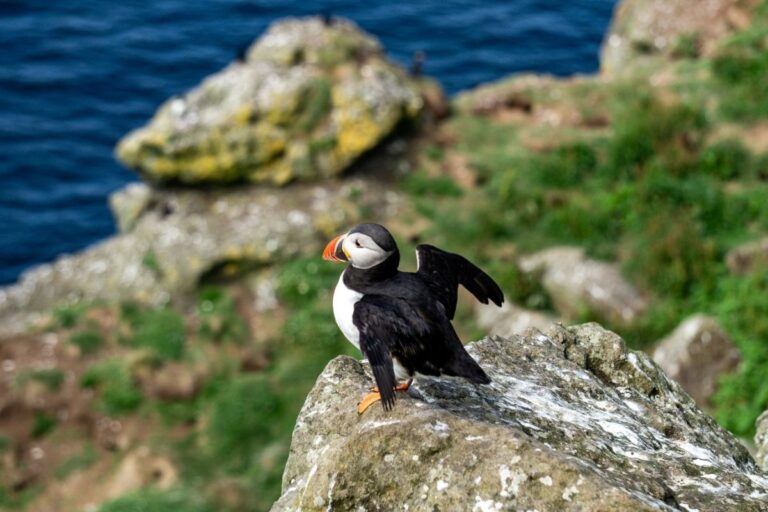
As we approached the emerald mass on the horizon, I noticed more and more birds skimming the water, their painted beaks and bright orange feet impossible to miss. We had entered the puffins’ domain.
There is nothing quite like spending an afternoon with a colony of charismatic Atlantic puffins. This guide covers the top places to see them, along with recommended boat tours, the best time to visit and how to respect the places they call home.
1. Lunga, Treshnish Isles

Lunga is a tiny island and seabird sanctuary in the Treshnish Isles. It’s home to around 13,000 puffins. The approach by boat is thrilling as they fly all around you.
Docking at the slipway, you walk carefully over the slightly uneven, rocky ground and up a steep grassy slope. Apart from a well-trodden trail, Lunga isn’t developed. There are no facilities on the island to preserve its wild habitat.
As you make your brief ascent, look out for puffins peering down from tussocks above. The top opens out to a ledge where hundreds sit preening outside their burrows. They look like rabbit warrens, and a cordon on the ground keeps you from getting too close.
Stay here or follow the path around the side of the cliffs. It’s uneven, and you should take care where you tread, as any crevice could be a puffin burrow.
On my wander, I was lucky enough to see a gang of razorbills plus a shag, and its fluffy teenage chick nesting in the space between two rocks.
The trail ends overlooking a raucous colony of guillemots. You’ll hear the din before you see the ledge facing a large rock covered in monochrome birds.
Both Staffa Tours and Turus Mara run sell-out tours to Lunga and Staffa during puffin season. I did my trip with Turus Mara and had two blissful hours with the puffins of Lunga.
The family-owned operator has been running small-boat tours in the Treshnish Isles for 50 years. It also facilitates vital puffin tracking by the Treshnish Isles Auk Ringing Group (TIARG).
2. Isle of May, Fife

Want to see puffins near Edinburgh? The Isle of May is the place! This national nature reserve in the Firth of Forth was once a Viking and smuggler stronghold. It’s now home to seals and seabirds, including seasonal puffins.
Summer is when the island is busiest, with puffins raising their chicks. You can follow the clifftop path, looking out for those telltale orange beaks. Keep an eye out for fulmars, gulls and terns.
Find a good spot and sit for a while. There’s nothing quite like being at eye level with a puffin. If you’re still, they’re more likely to interact with each other than watch you. Keep an eye out for ‘billing,’ a courtship ritual where a bonded pair rub their beaks together to reaffirm their bond.
The Isle of May has a tiny visitor centre with an indoor viewing area. There’s also an old lighthouse dating back to 1636, and the ruins of a 12th-century priory.
Anstruther Pleasure Cruises runs afternoon boat trips from Anstruther to the Isle of May from April to September. You get two and a half to three hours on the island, weather permitting. Go in June to see the new chicks. It’s a wonderful summer activity near Edinburgh.
3. Duncansby Head, Caithness


Duncansby Head is an accessible place to spot puffins from the mainland, and there’s no need to jump on a boat. This is the northeastern tip of Scotland, about two miles from John O’Groats. Walk from the town or park by Duncansby Head Lighthouse.
This sweeping stretch of coastline towers above the North Sea, shaped by jagged Old Red Sandstone cliffs. It’s the perfect puffin habitat.
Though not as numerous as Lunga or May, you can spot a few here and there perched on the rocks alongside razorbills and kittiwakes. Bring binoculars or a camera with a good zoom lens to spot them.
While puffin-spotting, you’ll be treated to jaw-dropping views of the Duncansby Sea Stacks. These offshore pinnacles stand 60m high above the water, sculpted by the North Sea over thousands of years. It’s not uncommon to see bottlenose dolphins and orcas swimming along this stretch of coastline.
4. Hermaness, Shetland Isles

The Shetland Isles are closer to the Arctic Circle than Norway’s capital, Oslo. This sub-arctic archipelago is one of the best places to see puffins (known locally as ‘tammie nories’), razorbills, gannets, fulmars, bonxies, Arctic skuas and Arctic terns.
Venture north to Hermaness on Unst, the best place to see puffins in Shetland. The nature reserve overlooks Muckle Flugga, the most northerly point of Britain.
It’s a seabird city during the summer months, with huge breeding colonies packed onto the rocks. There are thought to be between 20,000 and 30,000 puffin pairs here — about 5% of the UK population!
The walk from the car park to the clifftops takes about an hour. Stick to the well-maintained gravel paths and boardwalks, as most of the route traverses sensitive peat bogs.
For the best views, follow the Walkhighland trail, which takes you on a four-hour hike along the clifftops. Soak up windswept views of skerries and stacks, plus the Muckle Flugga Lighthouse, rumoured to have inspired Robert Louis Stevenson’s ‘Treasure Island’ after his visit in 1869.
Once you’ve found the puffins, sit and enjoy their company. If you stay quiet and still, these curious little characters will come quite close. You may be blocking a burrow if one appears to loiter nearby.
5. Castle o’Burrian, Orkney

If you can’t get quite as far as Shetland to see puffins, the Orkney Isles make a stellar alternative. The Castle o’Burrian off the east coast of Westray is Orkney’s best puffin hangout.
Despite its name, there isn’t a castle here. Instead, a large offshore sea stack is ruled by puffins from April to August. Up to 300 puffins nest in crevices on the rock, giving you a clear vantage point from the cliff trail opposite. Bring binoculars and a zoom lens for the best view.
Time your visit for early evening, as puffins tend to go out to sea during the day. At golden hour, these little birds perched among sea pinks are a magical sight
To get to the Castle o’Burrian, you’ll need to catch a NorthLink Ferry from Kirkwall to Westray. Drive to Rapness Mill car park or pick up the Westray Bus Service.
6. Staffa, Treshnish Isles

A colony of about 100 puffins live on Staffa. The small island in the Treshnish Isles lies just seven miles west of the Isle of Mull, and its biggest claim to fame is Fingal’s Cave, a gaping sea cave carved from hexagonal basalt rock.
Boat tours will take you into the mouth of the cave, playing the ‘Hebrides Overture’ by Felix Mendelssohn, which he composed after his visit. You can also walk along the inside wall of the cave when you make landfall on Staffa.
To find the puffins, climb up the (somewhat steep) steps from the jetty and follow the well-marked path down the length of the island.
You’ll come to a cliff edge, which is taped off to prevent you from accidentally treading on a burrow. The puffins here are a bit tricky to see as they live under an overhang. During my visit, most of them were out on the water, so binoculars came in handy.
Staffa Tours and Turus Mara feature Staffa on their tours. They give you about an hour to explore the island. The popular wildlife tour by Staffa Tours includes Lunga’s puffins, too.
7. Shiant Isles, Hebrides

Sandwiched between Harris, Skye and the mainland, the Shiant Isles are home to one of the largest puffin colonies in the UK. Around 60,000 puffins return to nest here each year, making up about 10% of the UK population.
They share their Hebridean home with huge numbers of fulmars, kittiwakes, guillemots and 7% of the UK’s razorbill population.
The Shiant Isles, meaning ‘the Enchanted Islands’ in Gaelic, are a privately-owned archipelago in The Minch. They comprise jagged basalt cliffs over 120 metres tall, bleached white with guano.
Arrival by boat is spectacular. On the way over, look out for common and Risso’s dolphins, harbour porpoises, minke whales and (if you’re very lucky) orcas and basking sharks. As you approach, seabirds soar overhead and the cliffs ring with their haunting cries.
The islands have been uninhabited since the 20th century, though there is a small basic bothy where you can stay the night. Isle of Harris Sea Tours runs day tours from Loch Tarbet on Harris.
8. Dunnet Head, Caithness

The northernmost point of mainland Britain, Dunnet Head, is a prime puffin-spotting location. Home to the RSPB Dunnet Head Nature Reserve, its rugged cliffs and grassy mounds attract a bustling seabird crowd, including puffins, guillemots, kittiwakes, razorbills and fulmars.
As you pass sandstone cliffs, look out for puffins perching precariously on the rocks. Coastline clefts, called geos, give you good vantage points to spot them framed by blooming sea pinks and white sea campion.
Make sure you stop by the Dunnet Head Lighthouse, set atop cliffs 91 metres above the Pentland Firth. Even at such a height, its windows have still been smashed by ferocious storms. From here, you have panoramic sea views and the Orcadian island of Hoy in the distance.
Dunnet Head is a popular stop on the North Coast 500 (NC500) road trip. There’s a car park behind the lighthouse and a paved path leading down to a viewing platform with a wall to protect you from the cliff edge.
9. St Kilda, Outer Hebrides

Nowhere else in the UK beats St Kilda for its sheer number of seabirds. Nearly a million nest here, including the largest UK puffin colony. There are around 130,000 breeding pairs.
St Kilda is the UK’s only dual UNESCO World Heritage Site, designated for its outstanding ecological and cultural value.
The now uninhabited archipelago shows evidence of over 4,000 years of human occupation. A village of 19th and 20th-century dwellings remains almost intact, abandoned after the island’s last residents left in 1930.
St Kilda’s gnarled volcanic cliffs are some of the highest in Europe, providing a sanctuary for the largest seabird colony in the north-east Atlantic. A dense population of northern gannets and fulmars have made the archipelago their noisy outpost.
Other birds include razorbills, guillemots, skuas, puffins and the endemic St Kilda wren. Surrounded by the Atlantic swell, it makes for a wild and awe-inspiring soundscape.
Lying 40 miles from the Outer Hebrides, St Kilda is an adventurous day trip, and it costs around £280. Sea Harris and St Kilda Cruises run boat tours from April to September, and include village visits on their itineraries.
The puffins of St Kilda are tricky to spot from land, as the islands are steep and craggy with exposed cliffs and territorial birds. Tour operators will sail around Dùn and Boreray, where numbers are concentrated.
As St Kilda is so remote, its puffins are truly wild, unlike those closer to the mainland, who are more accustomed to humans.
Where to see puffins in Scotland FAQs
Where do puffins live in Scotland?
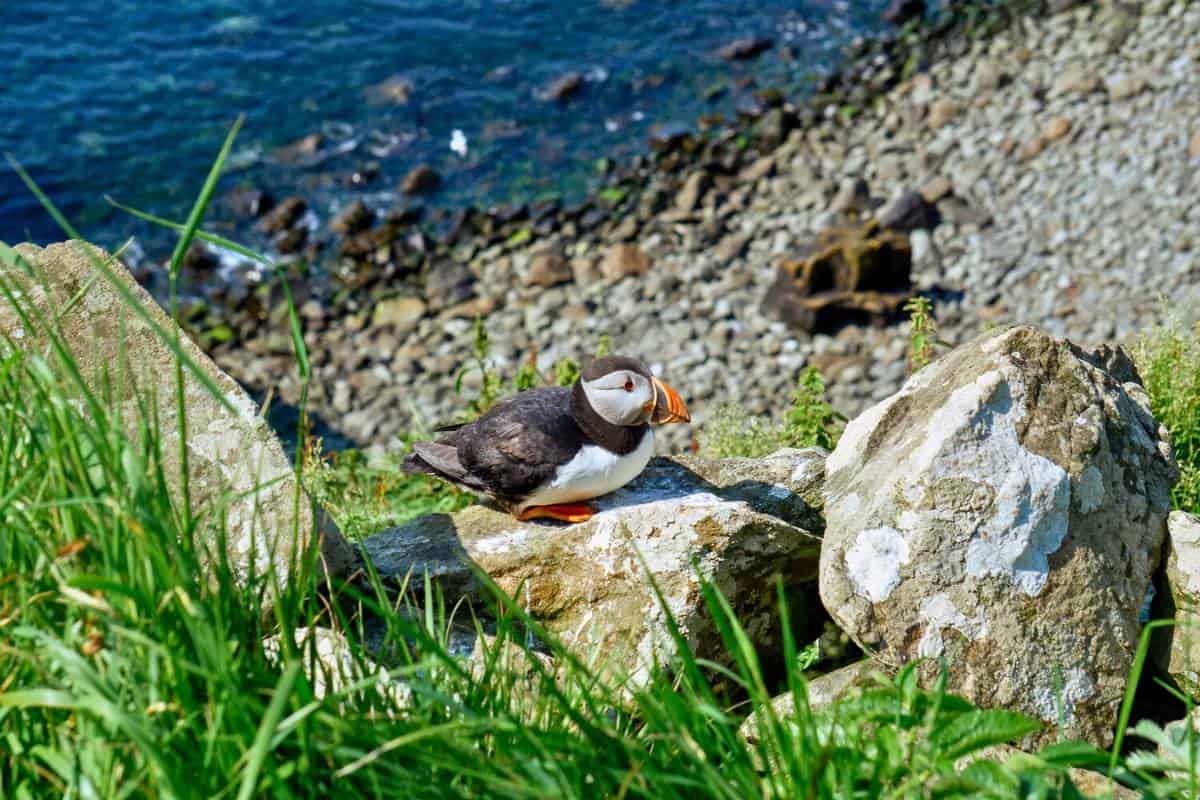
Puffins live in burrows buried on the clifftops high above the sea. You can find colonies on the mainland coast as well as remote islands.
When is the best time to see puffins in Scotland?
Puffin season runs from April to early August in Scotland, so aim for May to July to see them in large numbers. They mate for life and spend the spring and summer together raising their chicks, called ‘pufflings.’
June is the best time to see them feeding their hatchlings. Their food of choice is sandeels, and they can hold a dozen or more of these silvery fish in their beaks.
By the end of July and through early August, they leave their burrows to spend the winter months apart out in the Atlantic Ocean. Where they go is still a mystery.

How can I see puffins in Scotland?
You can spot puffins along Scotland’s coastlines for free on your own, but if you want to see big colonies, it’s best to book a boat tour to the islands. It’s a much more rewarding experience, and you feel as if you’re in their world.
Tour operators like Staffa Tours, Turus Mara and Anstruther Pleasure Cruises all give you time to yourself on the islands, so you can enjoy them at your own pace. Take care where you tread, as puffins burrow everywhere.
Where can I see puffins near Edinburgh?
The best place to see puffins near Edinburgh is the Isle of May. To get there, take the train to Anstruther in Fife and sail to May with Anstruther Pleasure Cruises. You’ll need to book your ticket well in advance as slots book up fast during puffin season.
An alternative is to head to North Berwick, where the Scottish Seabird Centre boat tours to May depart. It’s a good day trip from the city if you’re into seabirds, as you can also visit Bass Rock. This volcanic offshore outcrop hosts the world’s largest colony of northern gannets, with numbers exceeding 150,000 in peak season.
Where can I see puffins near Glasgow?
The closest puffins to Glasgow are on the Isle of May. You would take a train or drive to either Anstruther or North Berwick and jump on the boat from there.
Looking for a bit more adventure? Hop on the train (or drive) to Oban and do a boat trip to see puffins on Staffa and Lunga. The journey takes you through the most beautiful parts of the West Highlands and islands. Give yourself at least two nights in Oban as the Treshnish puffins are a full day out.
Can I bring my dog?
Due to the sensitive nature of these colonies, please don’t bring your dog. They could harm the puffins or cause distress, preventing them from raising chicks or returning the following year. Tour operators don’t permit dogs, and nature reserves require you to keep them on a short lead.
The Atlantic puffin population in the UK is in decline and could fall by up to 90% by 2050. Thankfully, numbers have increased in the Firth of Forth, the Farne Islands and the Treshnish Isles. This positive change is thought to be linked to the closure of UK industrial sandeel fisheries in 2024.

What should I pack for puffin watching?
These are my top essentials to help you have the best experience possible when spotting puffins in Scotland:
Camera & a Good Lens
It’s best to bring a mirrorless camera and a good lens so you don’t regret it later. I don’t want you to make the same mistake as me, and find most of your photos are blurry!
A good telephoto lens for wildlife is the Canon RF 800mm F11 IS STM.
If you just want some nice photos and aren’t too concerned about quality, your phone camera will do. I have a Google Pixel 7 Pro, which has a decent zoom.
Walking Boots
Pack a good pair of walking boots or shoes with ankle support, as you’ll be navigating uneven terrain. It’s easy to lose your footing when you’re distracted by cute puffins.
Binoculars
A good pair of binoculars will come in handy when you’re looking at birds from a distance. Use them to spot puffins bobbing about on the water or perched on sea stacks.
Snacks
Puffin watching tours and excursions tend to be quite long, so make sure you bring plenty of snacks and water to keep you going. As always, it’s vital you take all rubbish back with you to preserve the puffins’ habitat.
Sun Protection & Rain Gear
You’ll be spending at least a couple of hours in Scotland’s famously unpredictable elements. I had blazing sunshine on Lunga and torrential rain at Duncansby Head, so expect all types of weather. Your packing list should have sunscreen and rain gear to cover all your bases.
Final thoughts on where to find puffins in Scotland

Hanging out with the ‘clowns of the sea’ is such a special experience. Puffins are full of character, and I can easily spend hours watching them tottering about Scotland’s coastal clifftops.
If I had to pick one place to see puffins in Scotland, it would be Lunga. The island is accessible from the mainland with a boat tour. There are thousands of puffins here, and trips tend to include Staffa and Fingal’s Cave for a little more adventure.
With boat trips departing from Oban, you don’t need a car. The town is well-served by public transport, yet the remote wilderness of the Treshnish Isles is still within easy reach.
Puffins in Scotland are wild, and it’s a true privilege to be in their domain. The best encounters happen when we let them lead.
Looking for more Nature in Scotland? Check Out These Posts!
- An Epic Rewilding Experience in Scotland with SCOTLAND: The Big Picture
- 12 BEST Day Hikes In Scotland You Need To Experience
- 7 BEST Scotland Day Tours for Amazing Views
Inspired? Pin it for later!