How to Get Around the Scottish Highlands Without a Car
This post may contain affiliate / compensated links. As an Amazon Associate, I also earn from qualifying purchases at no extra cost to you. For full information, please see my disclaimer here. Thank you!
Can you get around the Scottish Highlands without a car? Yes! In this guide, I break down the public transport network in the Highlands and how you can use it for your trip.
When you think of the Highlands, you might picture remote roads winding through rugged glens far away from civilisation, but plenty of the best landscapes are reachable by train, bus and ferry.
As a non-driver, I rely on public transport in the Highlands. After completing dozens of car-free Highland trips over the past 10 years, I’ve learned which routes work and which don’t. Yes, it takes a little extra planning and time, but it is doable.
I’ve swapped winding roads for scenic railway lines and explored Glencoe by bus. I’ve taken a sleeper train to Inverness and watched the dawn break over the Cairngorms. I’ve travelled by bus down Loch Ness to Fort William and ferries to the islands, all without a car.
Whether you’re planning your first trip in the Highlands or want to leave the car behind, this guide is for you. I share how the network works, the best routes to take, the best places to visit and alternative ways to get around to cover more ground.
Getting around the Highlands without driving
The Scottish Highlands have an extensive public transport network that can take you around most of the region, even if you’re travelling without a car. Let’s break it down:
Trains
ScotRail is the main train operator in Scotland, and it has four major lines covering the Highlands. These include:
- The West Highland Line from Glasgow to Oban or Mallaig
- The Kyle Line from Inverness to Kyle of Lochalsh
- The Far North Line from Inverness to Wick and Thurso
- The Highland Main Line from Perth to Inverness
➡️ To get to the Cairngorms and Inverness, use the Highland Main Line.
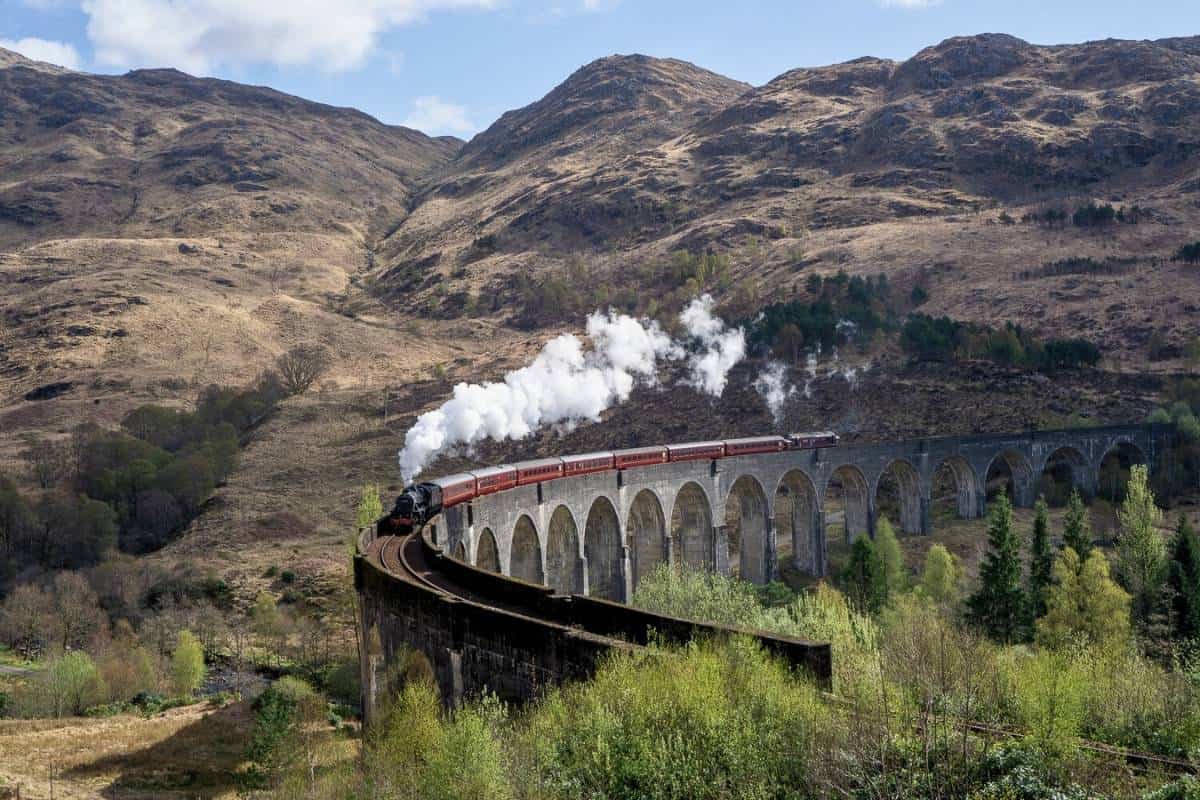
➡️ To explore Fort William, Ben Nevis and Glenfinnan Viaduct, take the West Highland Line. It’s one of the most scenic train journeys in Scotland!
➡️ To visit Loch Lomond without a car, take the train from Glasgow to Balloch or the West Highland Line to Arrochar & Tarbet.
➡️ To see the North Highlands and catch a ferry to Orkney, use the Far North Line.
➡️ To get to the Isle of Skye without a car, take the Kyle Line from Inverness to Kyle of Lochalsh, then take a bus across the Skye Bridge.
How to book tickets
If you’re travelling longer distances (an hour or more), it’s best to book train tickets in advance for the lowest prices.
You can book them up to 12 weeks in advance on the ScotRail website or app. I like to use Trainline, Rail Europe and TrainPal to compare prices. Sometimes, I can find a cheaper ticket!
In the summer of 2025, ScotRail removed peak fares to encourage more people to commute by train. All prices are now off-peak without restrictions on when you can travel.
I’ve noticed that the West Highland Line and the Highland Main Line get busy, and there are limited places to store luggage. I’ve had to sit by the carriage doors before.
Reserve your seats at the time of booking if you’d like a guaranteed place to sit. Reservations are printed on tickets attached to your seat. They can be a bit tricky to spot, so take your time.
For shorter journeys (a couple of stops or less than an hour), you can get away with booking your tickets on the day, as I’ve found prices are pretty cheap. Buy them online, at the ticket counter or at the machines located at most stations and pay with your bank card.
Editor’s tip: Passes and railcards can help you save money on train fares. Check Railcard to see if you’re eligible (you don’t need to be a UK resident). You could also look at BritRail, the Eurail Global Pass or ScotRail’s passes. I’ve not used them as I’ve found them quite restrictive.
Buses

Buses can help you reach places beyond the railway lines, giving you more freedom to explore the Scottish Highlands without a car.
They’re divided by region-specific local buses and long-distance coaches, including Scottish Citylink, Megabus and West Coast Motors.
Some bus routes in the Highlands I’ve used include:
- Inverness to Oban via Fort William (Scottish Citylink & West Coast Motors)
- Fort William to Portree on Skye (Scottish Citylink)
- Fort William to Glen Coe (Scottish Citylink)
- Aviemore to Cairngorm Mountain
- Fort William to Kilchoan for the Isle of Mull
- Inverness to Culloden Battlefield
Highland bus services aren’t very regular. I really recommend planning your route, so you can make your return journey. Use Traveline Scotland, not Google Maps, for this.
How to book tickets
You don’t need to book your tickets in advance on local buses. Just tap your bank card and say where you’re going when you get on. Buy a return ticket if it’s a day trip. Some buses offer day passes, which are handy if you’re planning to do a couple of stops.
For long-distance coaches like Scottish Citylink and Megabus, you need to book tickets in advance on their websites.
Coaches fill up, so book at least a few days ahead if you can. That being said, I’ve used Scottish Citylink to explore Glencoe, and I was fine booking my ticket the night before.
Ferries

Ferries in the Scottish Highlands are mainly operated by:
- Caledonian MacBrayne (CalMac) – serves the West Highlands and Hebrides
- NorthLink Ferries – serves Orkney and Shetland
- Pentland Ferries – serves the route from Gills Bay to Orkney
- Orkney Ferries – inter-island routes exclusive to Orkney
- Shetland Ferries – inter-island routes exclusive to Shetland
The main ferry ports in the Highlands that are easy to get to without a car are Oban, Mallaig, Uig on Skye and Scrabster on the north coast. Unless you’re heading to Orkney and Shetland, you’ll most likely use CalMac to visit the islands.
➡️ For the Isle of Skye, take the ferry from Mallaig to Armadale.
➡️ To get to the Isle of Mull, take the ferry from Oban to Craignure.
➡️ For Lewis and Harris, take the ferry from Uig on Skye.
Editor’s tip: Amenities onboard each ferry depend on the popularity and length of the route. Larger ferries have indoor and outdoor seating plus a canteen. Smaller ferries only have outdoor seating, so make sure you wear layers and a windproof jacket!
How to book tickets
You should always book ferry tickets in advance to guarantee your spot. Foot passenger tickets are not as limited as those for cars, but try to book at least the day before. I always book with CalMac directly online. It’s simple, and the ticket is sent to your email.
Make sure you’re waiting at check-in at the ferry port at least 15 minutes before the scheduled departure. If you buy your ticket on the day, you need to be there at least 30 minutes before.
Tours

I like to use tours to get to places otherwise inaccessible by public transport, too complicated to get to or when I want to cover a lot of ground. Buses and trains usually take much longer than joining a day tour.
The tour operators I use include:
They offer one-day and multi-day tours with a maximum of 16 passengers in a minibus (except Timberbush on tours to the Isle of Skye). Tours to the Highlands depart from Glasgow, Edinburgh and Inverness. I’ll cover some of the best tours I’ve done later!
How to book
You can book directly with Rabbie’s Timberbush Tours and Highland Explorer Tours. If I’m planning to do multiple tours and activities, I like to use GetYourGuide as it keeps all bookings in one place.
Always book your tours in advance. Popular routes like Inverness to the Isle of Skye or Glenfinnan Viaduct sell out quickly.
Use code FRANCESCA10 to get 10% off day trips when you book directly with Highland Explorer Tours. Not valid on tours featuring the Jacobite train, Military Tattoo or Highland Games.
Getting to the Highlands without a car

To understand how to get to the Scottish Highlands without a car, you first need to know where the region is.
The Highlands are the area north and west of the Highland Boundary Fault, a fault zone running from the Isle of Arran and Helensburgh on the west coast and Stonehaven on the east.
The exact Highland border is a little blurred, but it loosely runs up the boundary fault line, skirts around the eastern edge of the Cairngorms National Park and up to Nairn on the northeast coast.
Everything north and west is the Highlands, and everything south and east is the Lowlands. Since the area is big, work out where you want to go. Inverness and Fort William are the best places to start.
Inverness has a direct train service from Edinburgh, and Fort William is reachable by direct train from Glasgow. They’re both well-connected by public transport, as I’ll explain later!
Join My Free Scotland Travel Community!
Want more insider tips on exploring Scotland without a car? Click here to join my free private Facebook group: Scotland Travel Tips & Planning, with over 6,100 like-minded members.
The best places to visit in the Scottish Highlands without a car

These are the best car-free bases in the Highlands. I’ve chosen them for their public transport links and accessibility. You’re not limited to these places, though.
Use them as jumping-off points to explore areas nearby with trains, buses, ferries and tours.
Inverness
The capital of the Highlands, Inverness, is the UK’s most northerly city. It’s well-connected, with direct trains from Edinburgh, Kyle of Lochalsh and Wick. Buses and coaches link Inverness to Loch Ness, Fort William and the Isle of Skye.
Inverness has an airport with flights to London, Edinburgh, Orkney and the Outer Hebrides. You can also take the Caledonian Sleeper train from London all the way up to Inverness.
Many popular tours depart from the city, so it’s a brilliant base for exploring the Scottish Highlands without a car.
Aviemore
An hour south of Inverness by train, Aviemore is the largest town in the Cairngorms National Park. It’s on the railway line between Edinburgh and Inverness. Megabuses and Scottish Citylink coaches also pass through.
From outside the train station, you can take a bus up to Glenmore, where you’ll find Loch Morlich. You can also go to Cairngorm Mountain and ride the little alpine train to the summit.
The Strathspey Steam Train departs from Aviemore, travelling to Boat of Garten and Broomhill. I recommend booking tickets in advance.

Pitlochry
Pitlochry is on the same train line as Aviemore and Inverness, so it’s easy to get to by train. The town is an ideal base to explore the forests and foothills of Highland Perthshire. The Hermitage at Dunkeld & Birnam is just one stop south on the train, while Blair Castle is one stop north.
Buses can take you to Queen’s View, Killiecrankie and Bruar Falls and Queen’s View (one of Scotland’s most scenic viewpoints!). Scottish Citylink buses from Edinburgh to Inverness also pass through.
Fort William
Fort William is nicknamed the ‘Outdoor Capital of the UK.’ As the largest town in the West Highlands, it’s well connected by public transport.
It sits on the West Highland Railway linking Glasgow with Mallaig, making it one of the best places to visit by train.
The same line also serves the sleeper train from London and the famous Jacobite steam train from Fort William to Mallaig.
Buses from Glasgow to the Isle of Skye pass through Fort William. As do buses from Inverness and Oban. Local buses can also take you to Glen Coe village and the Glen Nevis Gondola.
Portree
Portree, the main settlement on the Isle of Skye, is connected by Scottish Citylink buses from Inverness and Glasgow. Regional buses also depart from the town, taking you to Uig, Old Man of Storr, Armadale, Sligachan, Dunvegan and around the Trotternish Peninsula.
If you don’t want to worry about bus timetables, local tours depart from Portree, including Tour Skye. I’d take the bus to the Storr, though, as tours don’t give you the time to walk up to it.

Oban
Oban is the gateway to the Inner and Outer Hebrides. Located on the west coast, it’s the final stop on the branch of the West Highland Line from Glasgow.
Scottish Citylink and West Coast Motors buses connect the town with Fort William and Inverness, so it’s an easy town to visit without a car.
At the ferry terminal, you can take Caledonian MacBrayne ferries to Craignure on the Isle of Mull, as well as Coll, Tiree, Colonsay, Barra and Lismore.
PLAN YOUR TRIP THE RIGHT WAY!
Skip the overwhelm and let me help. With my bespoke trip planning service, I can design a car-free Scotland itinerary for you that’s practical, stress-free and perfectly suited to your needs.
Best Scottish Highland tours

Below are a few of my favourite tours that cover the best of the Scottish Highlands. I much prefer small group tours like Rabbie’s over large coaches, as I feel less like I’m on a school trip! Check them out:
- Glencoe and the West Highlands from Glasgow – One of my favourite Rabbie’s tours. I saw Loch Lomond, Inveraray and Kilchurn Castles, Oban and Glencoe on a day trip from Glasgow.
- Loch Ness Day Trip from Inverness – The best way to explore Loch Ness without a car. The trip includes a visit to Dores, a cruise on Loch Ness and views of Urquhart Castle.
- John O’Groats and the Far North from Inverness – Dunrobin Castle and John O’Groats are huge highlights of this tour. The Duncansby Sea Stacks are an underrated gem.
- Isle of Skye Day Trip from Inverness – If you’re short on time but want to see the Isle of Skye, this hugely popular tour by Rabbie’s is worth it. It includes a stop at Eilean Donan Castle, which is tricky to see without a car!
- Loch Ness, Whisky & Outlander Explorer from Inverness – Perfect if you’re an Outlander or whisky fan, this day tour includes Culloden Battlefield, the Clava Cairns, a whisky tasting and entry to Urquhart Castle.
- Glenfinnan, Glencoe, and Highlands Day Trip from Edinburgh – This one is for you if you’d like to see iconic Highland sights, including Glenfinnan Viaduct and Glencoe, on a day trip from Edinburgh.
👉 Browse the best tours in the Scottish Highlands by clicking here!
Car-free itineraries for the Scottish Highlands

Wondering how to fit the Scottish Highlands into an itinerary without a car? My 10-day Scotland itinerary by train starts in Edinburgh and ends in Glasgow, with stops along the Highland Main Line, Kyle Line, Isle of Skye and down the West Highland Line.
I also have a seven-day itinerary where you do day trips to the Highlands from Inverness and Glasgow, and a 10-day west coast itinerary that focuses on the Isles of Skye and Mull.
My advice for planning the best Scottish Highlands itinerary is to pick a few well-connected places, like Fort William, Inverness or Aviemore and build your route from there.
For example, the bases on your trip (where you spend the night) could look like:
- Pitlochry
- Aviemore
- Inverness
- Fort William
Or to include the Isle of Skye, you could do:
- Inverness
- Plockton
- Portree (Skye)
- Mallaig
- Fort William
FAQs about visiting the Highlands without a car

Can you get to Loch Ness without a car?
Yes, you can. The number 16 bus departing from Inverness can take you to Dores, Inverfarigaig and Foyers on Loch Ness. The 919 Scottish Citylink bus from Inverness to Fort William also stops at Drumnadrochit, Urquhart Castle, Invermoriston and Fort Augustus.
These buses only run a couple of times a day, so be sure to check the schedule to avoid getting stranded. If you want to see a lot of places around Loch Ness without a car, I recommend doing a small group tour.
I did a Loch Ness day tour with Rabbie’s. It was a lot less hassle than trying to figure out the bus timetable myself. I did a cruise on Loch Ness, saw the amazing Falls of Foyers and Urquhart Castle in a day!
What are the most scenic train routes in the Highlands?
Trains are the best way to see the Scottish Highlands, as there are some stunning routes. The West Highland Line from Glasgow to Oban or Mallaig is the most beautiful. I’ve been lucky enough to ride it a few times, and I always have my nose practically pressed against the glass!
It skims Loch Lomond and up past the Arrochar Alps to Crianlarich, where the train splits. One half travels up past Corrour, the UK’s highest and most remote train station, then onwards to Fort William at the foot of Ben Nevis.
Crossing Glenfinnan Viaduct, it finishes at Mallaig. The other half travels to Oban on the west coast. Other scenic train routes include:
➡️ The Kyle Line from Inverness to Kyle of Lochalsh
➡️ The Far North Line from Inverness to Thurso and Wick
➡️ The Highland Main Line from Perth to Inverness
What is the cheapest way to visit the Highlands without driving?
The most budget-friendly option is cycling if you bring your own bike. Short-distance travel by bus or train is similar (e.g. the train from Pitlochry to Blair Atholl is £5.50, while I paid £3 for an adult single on the bus).
Intercity coaches like Scottish Citylink and long-distance trains are generally the most expensive ways to get around the Highlands.
Is public transport in the Highlands reliable?
Mostly reliable! Sometimes trains, ferries and buses are delayed or cancelled due to bad weather. Give yourself time before the scheduled departure and be prepared to wait, as there are often delays.
Train stations and ferry terminals usually have live departure boards, or you can check updates online. I’ve noticed buses can run late, so don’t panic if you’re waiting up to 30 minutes.
Try not to give yourself short connections in case of delays, and don’t rely on Google Maps for timetables. Traveline Scotland is much more accurate.
Where can’t you go in the Highlands without a car?
Remote Highland villages are difficult to access without a car. If there is a bus, it might only run a couple of times a day and take a good chunk of time to get there.
I wouldn’t recommend attempting the North Coast 500 by public transport. The northwest coast around Ullapool and Applecross is also very limited.
Stick close to towns and cities with a decent public transport network and use small group tours to get to more remote areas like Applecross or Torridon.
Final thoughts on the Scottish Highlands without a car

I hope you’ve found this guide to getting around the Scottish Highlands useful. The region is known for its remote natural landscapes that feel worlds away from civilisation, but you don’t need a car to get around.
Going car-free is a slower form of travel. You’re ruled by timetables and longer journeys, but you’re treated to scenic railways with jaw-dropping views and comfortable buses that let you relax rather than navigating unfamiliar roads.
Small group tours are my go-to for plugging in gaps or covering a lot of ground in a short amount of time.
Always check the timetable in advance, use Traveline Scotland to plan your route and don’t try to see everything. That’s the secret to exploring the Highlands without a car.
Want a Scotland trip without the hassle of planning? I’ll design a custom itinerary that takes care of the details, so you can simply relax and soak up the adventure. Click here to find out more!