Best Time to Visit the Isle Of Skye for the Perfect Trip (2026)
This post may contain affiliate / compensated links. As an Amazon Associate, I also earn from qualifying purchases at no extra cost to you. For full information, please see my disclaimer here. Thank you!
Wondering about the best time to visit the Isle of Skye? One of the most popular destinations in Scotland, Skye draws visitors with its ancient and fairytale-esque landscapes peppered with picturesque villages and medieval castles.
The weather serves as a dramatic backdrop to the island’s scenery. Fondly known as the ‘misty isle’, it’s not uncommon to see it shrouded in mist, clouds and rain throughout the year.
Since it’s an island, the weather is quick to change. However, the weather shouldn’t be the only factor to take into account when choosing the best time to visit. Peak tourist season and prices should also be considered.
I recommend visiting Skye in the shoulder seasons which are April to May and September to October for the best weather, fewer crowds, best wildlife and cheaper prices. Keep reading to find out why.
This article also dives into wildlife seasons as well as the best time to view the northern lights on Skye so you know exactly what to see and when.
PLAN YOUR TRIP WITH MY FAVOURITE RESOURCES
– Best accommodation site: Booking.com
– Book day tours here: GetYourGuide
– Book flights & rental cars in one place here: Trip.com
The best time to visit the Isle of Skye at a glance
Here’s a table to help you work out the best month to visit the Isle of Skye for weather and wildlife:
Month: | January | February | March | April | May | June | July | August | September | October | November | December |
Average temperatures: | 4℃ | 4℃ | 5℃ | 7℃ | 9℃ | 12℃ | 13℃ | 13℃ | 11℃ | 9℃ | 6℃ | 5℃ |
Average rainfall (days): | 17.3d | 13.4d | 14.2d | 10.8d | 10.1d | 10.3d | 12.5d | 13.8d | 14.7d | 16.5d | 16.6d | 17.0d |
Crowds: | Low | Low | Low | Medium | Medium | Medium | High | High | Medium | Medium | Low | Low |
Midges: | Low | Low | Low | Low | Medium | Medium | High | High | Medium | Low | Low | Low |
Wildlife: | Otters, Golden Eagles, Pine Martens, Seals, Sea Eagles, Red Deer | Otters, Golden Eagles, Pine Martens, Seals, Sea Eagles, Red Deer, Atlantic Salmon | Otters, Golden Eagles, Pine Martens, Seals, Sea Eagles, Red Deer, Atlantic Salmon, Puffins | Otters, Golden Eagles, Pine Martens, Seals, Sea Eagles, Red Deer, Atlantic Salmon, Puffins, Dolphins | Otters, Golden Eagles, Pine Martens, Seals, Sea Eagles, Red Deer, Atlantic Salmon, Dolphins, Whales | Otters, Golden Eagles, Pine Martens, Seals, Sea Eagles, Red Deer, Atlantic Salmon, Dolphins, Whales, Gannets | Otters, Golden Eagles, Pine Martens, Seals, Sea Eagles, Red Deer, Atlantic Salmon, Dolphins, Whales, Gannets | Otters, Golden Eagles, Pine Martens, Seals, Sea Eagles, Red Deer, Atlantic Salmon, Dolphins, Whales, Gannets | Otters, Golden Eagles, Pine Martens, Seals, Sea Eagles, Red Deer, Atlantic Salmon, Dolphins, Whales | Otters, Golden Eagles, Pine Martens, Seals, Sea Eagles, Red Deer, Atlantic Salmon, Dolphins, Whales | Otters, Golden Eagles, Pine Martens, Seals, Sea Eagles, Red Deer | Otters, Golden Eagles, Pine Martens, Seals, Sea Eagles, Red Deer |
Northern Lights: | Medium | Medium | High | Low | Low | No | No | Low | High | High | Medium | Medium |
Best time to visit: | ✓ | ✓ | ✓ | ✓✓ | ✓✓✓ | ✓✓✓ | ✓ | ✓ | ✓✓ | ✓✓ | ✓ | ✓ |
Isle of Skye weather and climate
Known as the ‘Misty Isle,’ Skye experiences a temperate oceanic climate thanks to the Gulf Stream and Atlantic Ocean that surround it. Summers tend to be cool and windy and winters are cold, windy and wet.
The weather is typically cloudy all year round and the average daily temperature is 11℃ / 51°F.
Overall, the weather and climate on Skye are fairly typical of Scotland. The country as a whole is no stranger to jokes about the wind and rain!
Rather than putting a damper on things, the weather adds an ethereal atmosphere to the landscape, giving it a lush green appearance in the mist.
The prevailing wind causes any rain showers you encounter to quickly pass.
Few places suit wind and rain better than Skye in my opinion – but keep reading if you’re keen to avoid it as much as possible!
Editor’s tip: prepare for your trip to Skye with my complete Scotland travel guide.
Skye weather by season

Let’s take a more in-depth look at the Isle of Skye weather by month and season. Although there’s no guarantee you’ll escape bad weather, some months give you a much better chance than others.
Spring
Months: March, April, May
Average maximum daily temperatures: 7℃ – 13℃ / 44°F – 55°F
Springtime emerges slowly on Skye, but it’s worth the wait. The cooler, wetter weather during the winter gives way to drier weather.
Wildflowers bloom, lambing season begins and waterfalls swell with melted mountain ice.
While March is still cool, May is much warmer. It’s also the driest month in the whole year which is something to consider if you want to escape the rain!
Pros: Low to medium crowds, less rainfall towards May, cheaper prices (outside school holidays), good amount of wildlife
Cons: School holiday half terms are busy, cool temperatures, not all attractions are open in March
Summer
Months: June, July, August
Average maximum daily temperature: 13℃ – 16℃ / 55°F – 60°F
The warmest months on Skye are predictably during the summer. The mornings and evenings are also lighter for much longer, giving you more time to hike and explore.
There’s more chance of brighter, sunnier weather – and the sunsets are glorious.
Tourism is in full swing during the summer so all attractions and activities are open.
However, summer is the busiest season on Skye so you’ll be competing with crowds, reduced availability and much higher prices.
Pros: Warmest weather, longer daylight hours, all attractions are open, lots of wildlife
Cons: High season and busiest time of the year, more traffic, more expensive, high chance of midges
Autumn
Months: September, October, November
Average maximum daily temperatures: 8℃ – 14℃ / 46°F – 57°F
During the autumn, temperatures begin to fall but you can still catch a crisp sunny day. There are much fewer tourists from September onwards so visiting popular spots is easier. Prices are cheaper too.
Autumn colours turn the island russet with pops of yellow and orange. Even the hills themselves turn thanks to the heather.
In October, the weather starts to get rainy. Some attractions operate on shorter opening hours. November is the beginning of the off-season.
Pros: Beautiful autumn scenery, fewer crowds and cheaper prices, good amount of wildlife
Cons: Higher rainfall and cooler temperatures, not all attractions are open from mid-October to November
Winter
Months: December, January, February
Average maximum daily temperatures: 6℃ – 7℃ / 42°F – 44°F
Skye’s winters are cold and rainy. The island experiences the most amount of rain during this season.
Daylight hours are much shorter which makes hikes and other outdoor activities harder. Snow and ice – particularly in the mountains – are also elements to consider. Remember to pack warm winter clothing.
There are much fewer crowds during the winter so you’ll have the place to yourself. Some attractions are closed for the off-season, including Dunvegan Castle and the Skye Museum of Island Life.
What about the Isle of Skye in December? Christmas and Hogmanay (New Year’s Eve) are magical times to visit Skye if you’re looking to hole up somewhere snug.
Pros: Low season so cheaper prices and fewer crowds, a medium chance of seeing the northern lights
Cons: Coldest and rainiest time of year, limited attractions are open, limited wildlife, possibility of snow affecting travel

Snow on the Isle of Skye

From December to February, it’s not uncommon to see snow on the Isle of Skye. Most of it falls in the hills and mountains rather than the lowlands but roads can still get icy all over the island.
Snowfall isn’t heavy thanks to the Gulf Stream and waters that surround the island. It’s nowhere near the amount of snowfall you can expect to see on mainland Scotland.
During milder winters, it rains a lot so you can expect them to be a bit of a washout.
Rainiest months on the Isle of Skye
The island’s rainiest season lasts for seven months out of the year. This is from the end of August to the end of March. January has the most rain, with an average monthly rainfall of 150 mm.
The drier months are from April to the middle of August. May is typically the driest month of the year with an average of 55 mm!
Average rainfall by days during the driest months:
- April – 10.8 days
- May – 10.1 days
- June – 10.3 days
- July – 12.5 days
- August – 13.8 days
Like I said, take this information with a pinch of salt. Most rain showers pass pretty quickly. As long as you bring waterproofs, you’ll be fine!
Just be careful if you intend to do any hiking around Skye as paths will get very muddy.
Isle of Skye peak season
If you’re taking into account the weather, summer is the best time to visit the Isle of Skye – but it’s also the busiest. That’s why I don’t recommend choosing a time of year just for the weather alone.
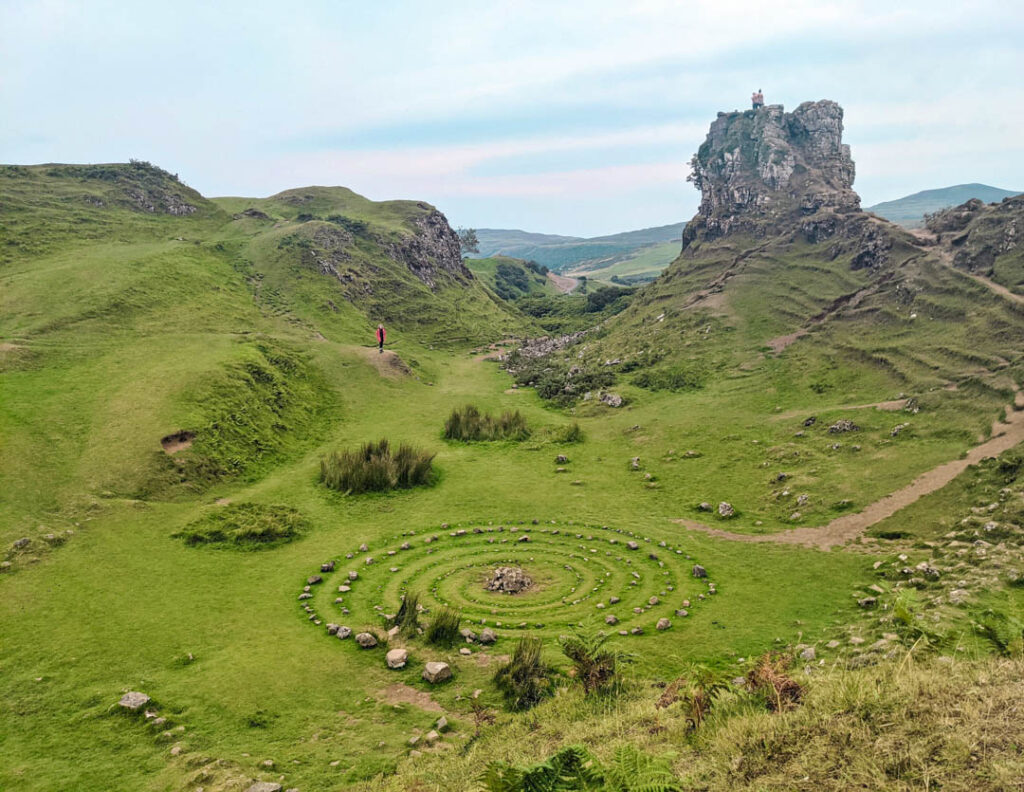
July to August is the peak season for tourists. Skye’s accommodation, restaurants and activities are much more expensive. Popular landmarks such as Fairy Glen, Fairy Pools and the Old Man of Storr get crowded too.
You’ll also be contending with a lot more traffic. The roads are busier plus cars and campervans have to compete for limited spaces in the car parks which, by the way, aren’t free!
If you want to avoid the crowds on the island I recommend visiting during the shoulder seasons. April and May are quieter (outside of school holidays) and the weather is mild and fairly dry.
September and October are good months too (again, outside of school holidays), but there’s a lot more rainfall.
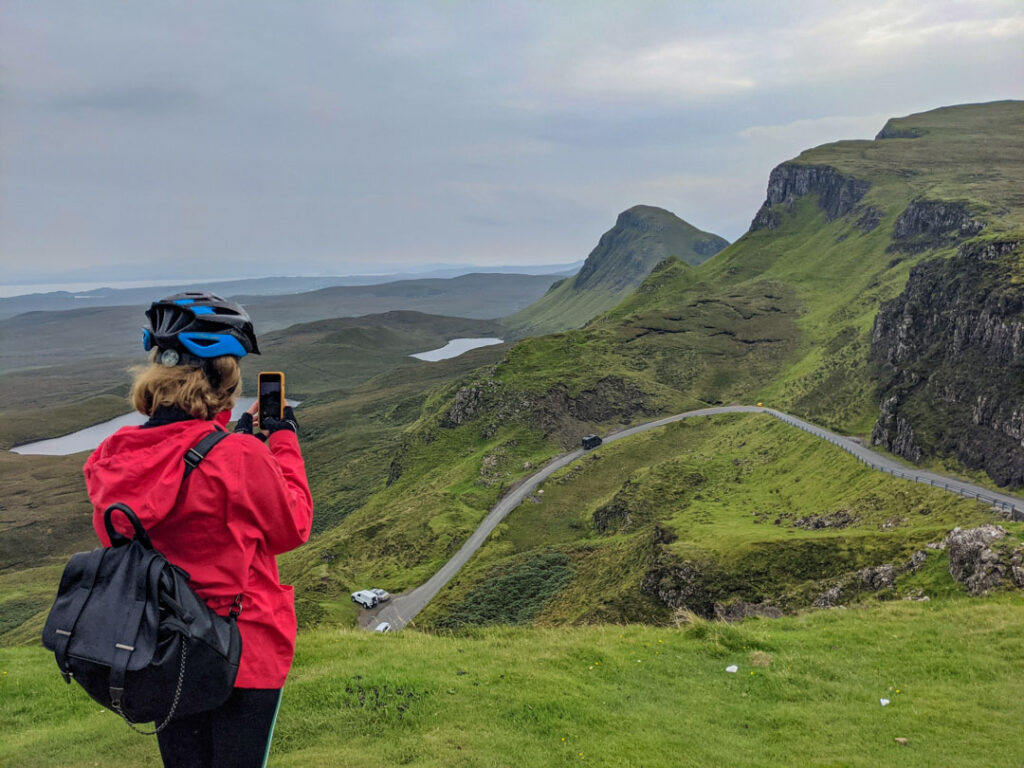
I visited Skye in the middle of September and the weather was a little cloudy but fine other than that.
There were still a few too many campervans than I would have liked when I cycled around the Trotternish peninsula though.
Editor’s tip: see all the best attractions on the Isle of Skye in this 2-day itinerary!
Cheapest time to visit the Isle of Skye
The cheapest rates for just about everything on Skye are found outside peak season.
You might find some good deals during the shoulder seasons but real bargains will pop up from November to March. In other words, the off-season.
Something to bear in mind again, not all attractions and accommodations will be open during the winter. Glamping sites in particular are seasonal.
The best time to visit to avoid midges on the Isle of Skye
Ah, midges. These teeny tiny balls of bite and irritation swiftly remind you that Skye isn’t quite heaven on earth…
These pesky flies are notorious around the West Coast of Scotland so it’s likely you’ll encounter them in the Highlands and islands.
I got set upon by midges during my visit to Skye, I’m sorry to say!
Midges fly in swarms and bite unsuspecting passersby. The bites aren’t dangerous but they can itch and swell when irritated.
You’ll typically encounter midges near water or marshy areas. They tend to be most prevalent at dawn and dusk too.
Midge season lasts from around May to September with July and August being the worst months. Essentially, milder weather brings them out to play.
Protect yourself by keeping the amount of skin on show to a minimum. The less of you there is exposed, the less there is to bite!
Covering yourself in citronella also helps.
If you’re camping, stick to coastal areas where there’s likely to be a breeze as a 2km wind speed is enough to keep them at bay.
Editor’s tip: see the best of the Highlands and islands in this Scotland itinerary.
Best time to visit Skye for wildlife

Midges aside – Skye has some wonderful wildlife that makes the island their home throughout the year.
Time and location are key to seeing these animals so if you want the best chance, I recommend doing a wildlife tour!
Here’s a quick list of what you can see, where and when:
- Otters – found around lochs and shorelines so kayaking is a good option. They can be spotted all year round.
- Golden eagles – one of the largest birds in the UK, they tend to nest high in cliffs. They can also be found all year round.
- Puffins – these seabirds visit the area between March to April, You’ll have better luck taking a boat tour to the neighbouring Isle of Canna rather than on Skye.
- Pine martens – a recent return, these creatures of the weasel family can be spotted all year round in the south of the island around Kyleakin and Sleat.
- Atlantic salmon – watching salmon leap up rivers is a sight to behold! You can see them as early as February but your best chance is from mid-June to mid-October on the River Snizort.
- Gannets – the largest seabird in Scotland, gannets can be seen from a boat or cliff top. The best time to spot them is from mid to late summer.
- Seals – common and grey seals can be spotted in Skye’s sea lochs and bays all year round. The small islands near Dunvegan Castle are home to a seal colony.
- Whales – The most common whale you can see is the minke from May to October. Do a boat tour to get the best chance of spotting them.
- Dolphins – bottlenose and common dolphins are a typical sight around Skye’s waters. The best time of year is between April and October.
- Sea eagles – the largest bird of prey in the UK, these birds are known to hang out around the cliffs near Portree all year round.
- Red deer – Skye’s red deer population are found on higher ground during the summer and in the lowlands during the winter.
Best time to see the northern lights on Skye

It’s certainly possible to see the northern lights – aurora borealis – on the Isle of Skye. However, don’t expect the show to be quite as pronounced as the displays you would get further north in the Arctic Circle.
The northern lights in Scotland appear as a faint white glow rather than colours due to the country’s latitude. You might see more colour if you use the long exposure on your camera.
To be in with the chance of seeing the northern lights, you need to be somewhere high up and without light pollution. It also has to be a clear night.
The best location on Skye is Glendale, an estate on the northwest coast of the Duirinish peninsula. There, you can see the northern lights during the winter months with spring and autumn being the best times.
Specifically, the best months for aurora sightseeing are March, September and October around the equinoxes. You’ll never see them in June or July as the nights are too light.
You can also enjoy other astronomical spectacles such as the Milky Way and meteor showers.
On a clear night, head to the shores of Loch Pooltiel with a camera and tripod. Use this (relatively clunky but supposedly accurate) app and get aurora forecast alerts.
Quick tips for visiting the Isle of Skye
Here are a few quick tips to help you make the most of Skye, whichever time of year you choose to go:
When to book your trip
Skye is a popular destination – especially in the summer months. I recommend booking your accommodation and any other activities as soon as possible before you travel as they tend to sell out fast.
The same goes for dining out. If you’ve got a few restaurants in mind you’d like to visit, make a reservation as early as you can because chances are small of you getting one on the day.
If you do this and don’t end up going, make sure you cancel at least a few days before so they can get other customers in time.
What to wear on the Isle of Skye
Skye’s generally cool, misty, damp and changeable climate means that layers and waterproofs will be your best friend.
Bring clothes you can take off or put on whenever you need to. Ideally, lightweight so you can carry them easily. I also recommend wearing walking boots if you’re planning to explore some of the incredible scenery.
Wear long sleeves and long trousers to fend off the midges. They’ll go for any exposed skin!
What to pack for the Isle of Skye
My tip essentials for visiting the Isle of Skye any time of year include:
- Citronella midge repellent (or bug spray as long as it’s DEET-free)
- Vegan walking boots like these ones
- Water-to-Go filtered water bottle
- Lightweight rain jacket
Editor’s tip: wondering what else you need to pack? Check out my complete Scotland packing list for every season!
So, when is the best time of year to visit the Isle of Skye?

If you’re still looking for a clear and definitive answer on the best time of year to visit Skye, I’m afraid it comes down to personal preference.
From personal experience, I would avoid the summer months as they’re just too busy and expensive.
Instead, opt for spring or if you don’t mind a bit of rain, autumn is a lovely time too. These seasons see plenty of wildlife, mild weather and fewer crowds. Plus, they coincide with my favourite time to visit Scotland overall.
Winter is pretty but not ideal if you are hoping to tick off some of the main attractions.
Looking for more Scotland travel tips? Check out these articles!
- 15 Best Places To Stay On The Isle Of Skye (For Every Budget!)
- 9 Best Scotland Small Group Tours You Need To Book
- 13 Awesome Day Trips From Edinburgh By Train Or Bus
- 20 Best Things To Do On The Isle Of Mull
- 10 Best Fort William Day Trips: Hikes, Castles And Epic Train Journeys
Pin for later!