A Complete Petra Itinerary: How To Spend A Day In Jordan’s Ancient Wonder
This post may contain affiliate / compensated links. As an Amazon Associate, I also earn from qualifying purchases at no extra cost to you. For full information, please see my disclaimer here. Thank you!
The Rose City, the Lost City, Raqmu…the ancient City of Petra in Jordan goes by many names. Perhaps most famous of all is its New Seven Wonders of the World title which has given it a travel bucket list status.
Petra stands among true legends and no trip to Jordan is complete without visiting this remarkable city carved from sandstone cliffs.
In this Petra itinerary, I share how to make the most of your time if you have one day in Petra and additional tips if you have two.
From photographing the iconic Treasury to finding the city’s best viewpoints and more, read on to discover how to visit Petra, Jordan.
Is Petra worth visiting?


Yes! Petra is the most popular historical landmark in Jordan and one of the biggest bucket list sites in the world.
Carved into colourful sandstone cliffs, It’s not for nothing that Petra is a UNESCO World Heritage Site and one of the New Seven Wonders of the World.
Petra’s history and archaeology have captured imaginations for centuries. This city was built in the 3rd century BCE and became a thriving capital and trade centre of the Nabatean Empire.
The Roman Empire expanded into the Middle East and took control in 106 CE until around the eighth century when the city was all but abandoned after a series of earthquakes.
Petra was lost to the Western world for hundreds of years until the 1800s when a European explorer disguised himself in Bedouin clothes and gained access to the extraordinary site.
In 1985, Petra Archaeological Park became a UNESCO World Heritage Site and in 1989 it was a famous filming location for Indian Jones and the Last Crusade.
In short, get yourself to Petra!
Best time to visit Petra

Seeing Petra requires a lot of walking around outdoors so the best times of year to visit are spring (March to May) and autumn (September to November).
In spring, temperatures hover around 20 to 30 degrees Celsius and the weather is sunny. In autumn, highs of 34 degrees drop down to 22 degrees Celsius.
Depending on how susceptible you are to the heat, the mid-20s are bearable to walk around in but make sure you wear breathable clothing and sun protection. Bring plenty of water with you too.
In summer, you can expect temperatures to hover around the mid-30s which will make hiking much less enjoyable. Winter sees temperatures ranging from four to 17 degrees Celsius, so wearing layers is essential.
Petra’s opening hours are also influenced by the seasons. It’s open from 6 a.m. to 6 p.m. in summer (starting from the 29th of March) and from 6:30 a.m. to 4 p.m. during the winter (starting from the 27th of October).
The best time to visit Petra is either late spring or early autumn as they give you the longest opening hours and the most pleasant weather.
I went in mid-May. It was already pretty hot but not unbearable as long as I took plenty of breaks. If you prefer slightly cooler weather, the best month to visit Petra would be April.
How to get to Petra

The distance between Amman and Petra is around 143 miles with the journey taking just under three hours by car. Aqaba in the south is closer at 78 miles and around two hours of driving.
If you’re driving from Amman, it’s mostly straight down Route 35, but I recommend breaking the journey up over several days. At the very least, you should make a detour to the Dead Sea!
Driving up from Aqaba, the fastest route is mainly along the Desert Highway. While it’s theoretically possible to do Petra as a day trip from Aqaba, you will be exhausted.
Stay at least two nights near Petra if you can. One night on either side of your visit.
If you’re wondering how to visit Petra if you don’t drive, there are one-day and multi-day excursions departing from either Amman or Aqaba. The best ones are:
- Amman: Petra, Wadi Rum, and Dead Sea 2-Day Tour
- From Aqaba: Petra 1 Day Tour
- Petra Full-Day Private Tour from Amman
- Amman: Transfer to the Airport, the Dead Sea, or Petra
Another option would be to do a tour of Jordan which includes a visit to Petra. G Adventures does small group tours in Jordan and Original Travel does private tours.
I also saw a group of people doing an adventure multi-sport tour with Intrepid Travel while I was there!
Alternatively, ask your hotel about private transfers to Wadi Musa (the nearest town).
Editor’s tip: Personally, I wouldn’t choose an excursion which does Petra and Wadi Rum in a single day. It’s too much to cram in and you won’t be getting your money’s worth in either place.
How many days in Petra

How many days you should spend in Petra depends on how long your itinerary in Jordan is overall.
At over 100 square miles in size, it’s impossible to see the entire city in a day but you can hit most of the key highlights if you plan it well (this guide will show you how, so keep reading!).
Two days in Petra will give you the chance to explore at a more leisurely pace and add on a few more hikes depending on your energy levels.
Three days will allow you to go further off the beaten track and maybe even do the Petra to Little Petra hike.
I spent one day in Petra. I felt that it was enough time to see everything I wanted to and do some hiking away from the crowds.
For most people, one day in Petra is enough, particularly for a seven to 10-day Jordan itinerary.
How much does it cost to go to Petra, Jordan?
Access to Petra and the iconic Treasury is permitted only with a valid entrance ticket.
The right ticket for you depends on who you are and how long you intend to stay in Jordan. It’s slightly complicated so I’ll break it down:
If you stay more than one night in Jordan and you don’t visit Petra on your first day, entrance fee prices are as follows:
One-day entry | 50 JOD (Jordanian Dinar) |
Two-day entry | 55 JOD |
Three-day entry | 60 JOD |
If you’re doing a day trip to Petra from another country and you’re not staying the night, the price is:
One-day entry | 90 JOD |
If you plan to stay in Jordan for more than one day but visit Petra on your first day, you’ll pay 90 JOD and then receive a refund of 40 JOD once you’ve stayed overnight.
As you can see, visiting Petra is easiest on your second or third day in Jordan. In my Jordan itinerary, I went there on my fifth day.
Children under 12 have free entry.
Editor’s tip: Entrance to Petra is included in the Jordan Pass among 40 other attractions. Pass prices start from 70 JOD for a minimum three-night stay in Jordan.
How to get around Petra

The best way to get around Petra is to walk. Granted you will need a moderate level of fitness and a good pair of shoes as the Treasury alone is a 30-minute walk from the entrance.
The passage that leads down to the Treasury and the valley floor (known as the Siq) is bendy but relatively flat so it’s possible for those with mobility aids and wheelchairs to reach it.
Another option is getting a golf cart to take you through the Siq to the Treasury.
It’s common to see people offering rides on camels and donkeys or ponies pulling carriages in Petra but I recommend staying well clear of them.
These animals are badly treated and forced to carry tourists all day long in the scorching desert heat. They’re beaten, denied water and sustain horrible injuries. It was uncomfortable to see.
On more than one occasion, I was also almost run off the path by a pack of out-of-control donkeys with slightly panicked tourists bouncing around on their backs!
So, to reiterate. If you can, walking and golf carts are best. Only do what you feel you’re able to. If that means seeing the Treasury and staying on the valley floor then that’s perfectly fine.
If that means attempting a few trails with lots of rest along the way like I did then that’s fine too. Whatever makes you comfortable!
Your complete one day in Petra itinerary

For this itinerary, I won’t tell you exactly what to do in Petra at each hour of the day as I don’t believe in having such a regimented timetable.
Instead, I’ve given a ballpark of where to aim for during the morning and afternoon with the notable places to visit in Petra along the way.
The one exception is that I really do recommend you get to Petra by 6 a.m. as the temperature is cooler, you have more time to explore and there are fewer people.
This means you get an almost uninterrupted view of the Treasury before the crowds descend!
Here’s a quick overview of your one-day itinerary to help you make the most of the best things to do in Petra:
- Stay in Wadi Musa the night before
- Get to the entrance at 6 a.m. when it opens
- Walk 30 minutes along the Siq to Petra Treasury
- Spend some time taking in the view of the Treasury
- Continue walking to the Petra valley floor
- Explore the main attractions on the valley floor like the Colonnaded Street
- Stop for lunch, relax and come up with a game plan for the afternoon
- Choose one or two hikes to do in the afternoon depending on your energy levels. I walked to the Monastery first and then to the High Place of Sacrifice
- After returning to the valley floor, head back towards the entrance
- Relax at your hotel for a few hours and eat some dinner
- Return to Petra at 8:30 p.m. to see Petra by Night
Morning in Petra


Don’t forget to pack sunscreen, a hat, a backpack with snacks, water and lunch, a camera, a phone, a portable power bank and cash.
Petra Visitor Centre
Start your Petra Jordan itinerary by arriving at the visitor centre at 6 a.m. when the doors open.
Once you’re through, you’ll come to a square with souvenir shops and bazaars. There’s also the Petra Museum but it won’t be open until 8:30 a.m.
Remember to pick up a paper map while you’re here.
Obelisk Tomb
Leave the visitor centre and follow the well-marked track towards Bab Al Siq. The first inkling of what awaits you in Petra is the Obelisk Tomb, an ornate sandstone carved into the rock close to the beginning of the Siq.
It’s the first of thousands of Nabatean tombs embedded in Petra’s rock but it’s no less of an exciting sight to see.
The Siq
As you continue along the track, you’ll come to the beginning of a passage which leads you through a spectacular narrow sandstone gorge as you approach the eastern entrance of Petra.
This passage is known as the Siq. It officially starts at a modern dam which was built on top of a Nabatean dam in 1963 to prevent floodwater from entering the gorge. If you look up, you’ll see the remains of the city’s gate.
On both sides of the gorge, there is evidence of water channels which provided the city with fresh water from Wadi Musa.
There are some toilets here if you need them.
Petra Treasury (Al Khazneh)


Eventually, the almost a-mile-long Siq opens out into the Petra Treasury (called Al Khazneh in Arabic). You get a wonderful reveal as it emerges behind the rock.
The Treasury is probably the most iconic part of Petra. It’s an enormous 40-metre facade and it’s thought to have been built in the 1st century BCE.
Its original purpose is unclear but archaeologists believe it was built to be a memorial for royalty.
I think its most awe-inspiring feature is that it was carved by hand!
Quick tip, if you’re looking for a good photo spot here look out for local Bedouin guides who will take you to two great places for a bit of cash.
The first one is a bit of a scramble up steep rocks to a ledge which is opposite the Treasury and looks down on it.
The scramble is tough but worth it and the guides make sure you get up safely. I saw a young Bedouin lad half-carry a 60-year-old woman up and down so it’s doable!
The other spot is at ground level. You sit on the curve of a rock with the magnificent Treasury peeking out from behind it.
Street of Facades
Once you’ve had your fill of the Treasury, it’s time to move further into Petra. The Siq widens out onto an open space called the Street of Facades. It was given its name thanks to the Nabatean tombs carved into the surrounding cliffs.
The Theatre
The next notable place in Petra is the Theatre which is carved into the foot of a mountain. It was originally built by the Nabateans some 2,000 years ago before it was renovated by the Romans to hold more than 8000 spectators.
City Centre
Once you pass the theatre, you’re standing at the point where the valley opens out onto a great plain. This is essentially, Petra’s city centre or the valley floor area. Keep going as there’s still more to see!
Royal Tombs
As you walk out into the open plain, the Royal Tombs are behind you. These are some of the most spectacular tombs in Petra despite some of the intricate facades being worn away by the elements.
Notable tombs here are the Urn Tomb, the Silk Tomb, the Corinthian Tomb, and the Palace Tomb. They’re accessible via a set of steps that ascend from the valley floor or you can admire them from a distance and keep going (I did this).
Colonnaded Street
Next, you’ll come to Colonnaded Street which was first established by the Nabateans and renovated by the Romans. It’s essentially, a high street where most of the city’s shopping area would have been. The street is lined with porticos on one side.
There’s a set of steps which leads to a market and the remains of a fountain shaded by a juniper tree.
The Petra Pool and Garden Complex
This collection of large terraces at the side of Colonnaded Street was thought to be ornamental gardens bisected by walkways. There was also a swimming pool with an island pavilion.
Petra’s Sacred Corner
At the far end of Colonnaded Street is the sacred corner, so called for its collection of temples and churches in this area.
You’ll see the remains of the Great Temple and Qasr Al-Bint with the Temple of the Winged Lion on the opposite side.
There’s also a Byzantine church with some gorgeous mosaics which you can have a look at if you have time.
Lunchtime in Petra

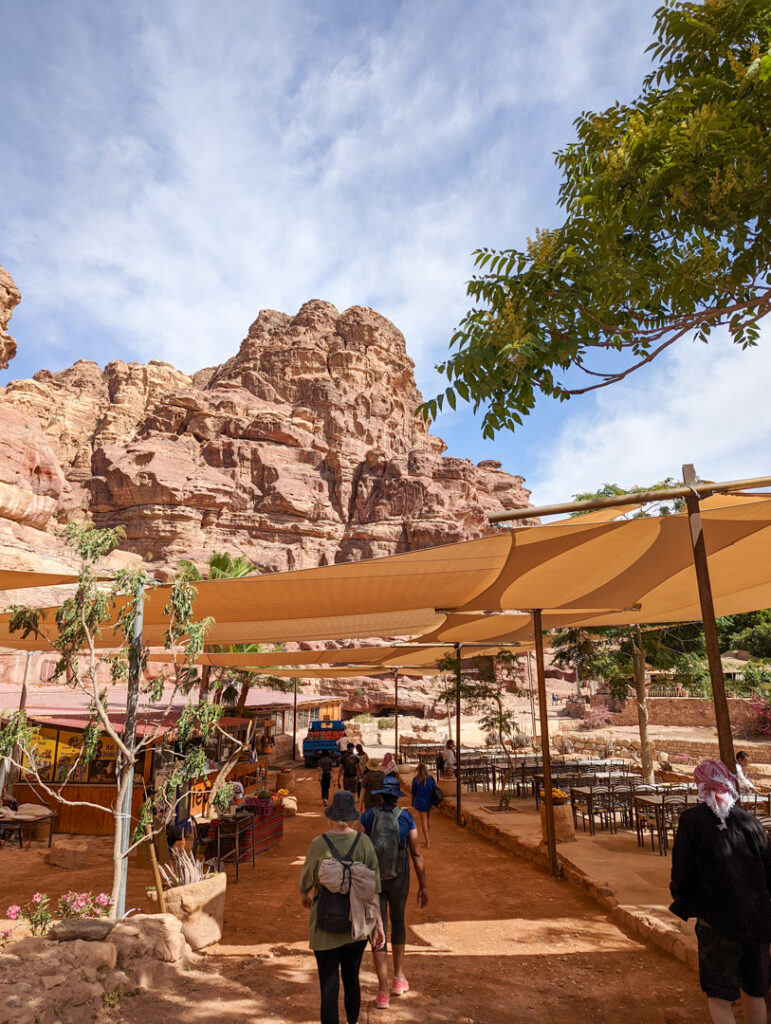
After the sacred corner, you’ll come to the area with restaurants and toilets. Stop here if it’s not too busy.
There should be some benches under the shade of a tree to eat your lunch or grab a bite at either one of the restaurants nearby.
I do recommend stopping for a bathroom break here as they become few and far between on your afternoon hikes.
As you eat lunch, think about which hiking trails you would like to do in the afternoon. I may be a bit biased but I definitely think the Monastery trail should be one of them!
Afternoon in Petra

After being suitably fed and watered, it’s time to do more exploring to make the most of your one day in Petra itinerary.
I recommend doing the Monastery hike as you’re rewarded with the most gorgeous views in Petra after the Treasury.
Petra Monastery Hike
The great thing about this trail is that you’ve already been walking in the direction of it.
After lunch, simply keep going in the opposite direction to Colonnaded Street through Wadi ad-Dayr. The distance is about 2.5 miles from there.
Fair warning, this hike has a moderate difficulty level and you’ll need to climb 850 steps. Don’t worry, they aren’t too steep. It will take around an hour to get to the top, but feel free to take plenty of rest stops along the way.
Some of the trail is lined with stalls selling trinkets and souvenirs. About two-thirds of the way up, you’ll come to a holy spring.
Eventually, you’ll arrive at a vast plateau surrounded by a panorama of mountains. Walk out onto it and the Monastery (otherwise known as Ad-Dier) will emerge from behind sheer rock.
The Monastery is a towering facade measuring 42.8m high. It was constructed in the style of the Treasury sometime early in the 2nd century CE.
Before heading back down the way you came, walk in the opposite direction of the Monastery towards the far end of the plateau.
There, you’ll find a small cafe in a cave with some incredible views looking down onto the Monastery on one side and the peaks of Wadi Araba 1000m below on the other.
Hike to the High Place of Sacrifice
Once you’ve made your way back down to Colonnaded Street from the Monastery, head back to the theatre for your final hiking trail of the day (depending on how much energy you have left!).
A set of steps leading up past the theatre signifies the start of the trailhead and it’s about 1.9 miles from there.
It’s a challenging trail with lots of steps leading you up a rocky slope but they’re well-established and there are no scrambles involved.
It’s not as busy as the Monastery trail but you’ll still come across other hikers and Bedouin stalls.
The ascent takes about 40 minutes with plenty of ancient Nabatean architecture along the way such as 6m high obelisks.
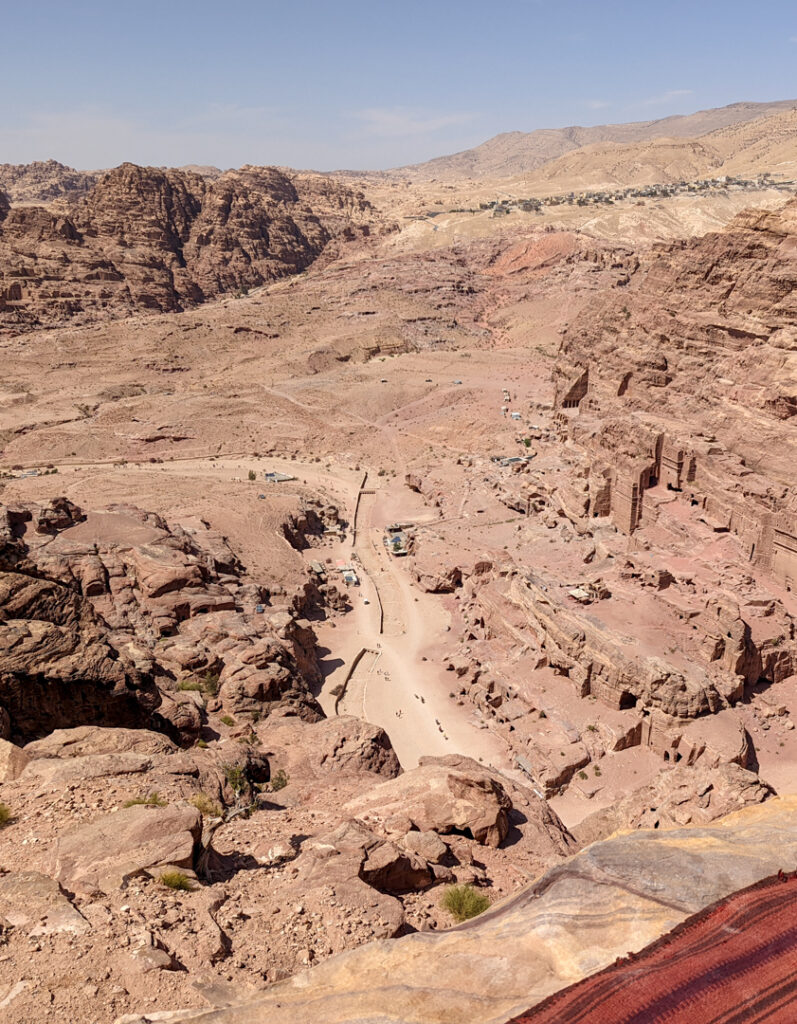
Once you make it to the top, the summit has been hand-chiselled to create a flat plateau with sheer drops 170m down. It’s one of the highest viewpoints in Petra.
Be very careful about approaching the edge as it’s a long way to the bottom and there’s nothing to break your fall. It’s not one for those who suffer from vertigo.
The plateau is safe enough and you can also see the remains of a dais which once had a table for sacrificial ceremonies.
There’s also a Bedouin tent here serving light refreshments and souvenirs.
You can either return the way you came or follow the Wadi al-Farasa Trail which takes you through a secluded canyon. I did the former as I was exhausted and ready to head back.
Evening in Petra

Petra by Night
Petra by Night is an evening event which runs every Monday, Wednesday and Thursday. The Siq and the Treasury are lit up by candlelight, accompanied by music and stories.
You learn a little bit more about the history of the Nabatean city and the Bedouins who once lived in the caves here. Some still do, unofficially.
It’s a nice little event to add to your Petra itinerary if you have enough energy after your day of walking. It starts at 8:30 p.m. and finishes at 10:30 p.m. Tickets cost 17 JOD.
Want to do two days in Petra?
Planning a Petra two-day itinerary? Explore the archaeological site at a more leisurely pace or add on a few more walking trails like the ones below:
Royal Tombs and Al Khubtha Trail
This is another stunning trail which ends in a Treasury viewpoint. If I went back to Petra, I would do this one next. It’s 2.2 miles but it has a hard difficulty level so allow at least two to three hours to complete it.
The trail starts from the main trail after the Street of Facades. It soon becomes a strenuous uphill climb but you’re rewarded with a beautiful view of the Treasury below.
The route is not as popular so you pretty much have that viewpoint to yourself too.
Al-Madras Trail
This short trail is famous for being featured in Indiana Jones. It’s much shorter than the others, about 0.9 miles and roughly 90 minutes to complete. Make no mistake, there are still some tricky bits. To give it a moderate difficulty level.
It starts from the entrance of Al Siq and leads you along narrow paths to the Obelisk Tomb, an oil press and an old bridge until you eventually reach a high place.
This trail is a little harder to navigate than the others and it’s prone to flooding during the winter.
Editor’s tip: If you’re wondering whether you need a guide to explore Petra…not for the hikes mentioned here or the main trail. I recommend a guide if you’re going further afield to Little Petra or to trails on the outskirts of the park.
Where to eat in Petra

There are a few places to eat and drink inside Petra itself. At the end of some walking trails and nearby key attractions, you may see small kiosk cafes and traditional Bedouin tea stalls serving light refreshments.
There are two main restaurants on the valley floor, close to the start of the trail up towards the Monastery on each end of Colonnaded Street.
The Nabatean Restaurant is a cooperative which supports 40 local families. It’s expensive and you’ll need cash. To be honest, it doesn’t have the best reviews so eat there at your own risk.
The Crowne Plaza Hotel owns the Basin Restaurant. It offers buffet-style dining and air-conditioned tables inside. Again, it’s quite pricey and it’s a good idea to bring cash.
If you’re not convinced by the food offerings or prefer to save your cash, bring a packed lunch with you and some snacks. There are a couple of bakeries and supermarkets in Wadi Musa that you can stop by the day before your Petra itinerary.
If you can bring a small cool bag, your food won’t spoil in the heat. I learnt the hard way with a sweaty orange in a plastic bag…
Where to stay in Jordan to visit Petra

I recommend staying in Wadi Musa the night before you visit Petra. It’s the closest town to the archaeological site and you’ll be able to get to the entrance in time for when it opens.
I stayed at the Seven Wonders Hotel. It’s a no-frills but comfortable hotel with a rooftop terrace and swimming pool. The hotel is a six-minute drive from Petra or 30 minutes on foot.
If you want somewhere cheaper to stay and closer to the archaeological site, Petra Cabin Hostel is just a 10-minute walk away and it’s very good value for money. It’s rated 8.8 on Booking.com.
Nomads Hotel is another good option with a mix of dorms and private rooms. While walkable, it’s at the top of a steep hill which might finish you off after a day on your feet!
Wondering where to stay in Petra if it’s even possible? Petra Guest House Hotel is a luxurious four-star hotel located a mere few metres away from the entrance.
It’s the closest (official) place to stay to the archaeological site.
What to wear in Petra, Jordan

For Petra, breathable, lightweight clothing is key as you’ll be exposed to the sun and heat the whole day.
Wear loose-fitting clothes that you’re comfortable walking in so they don’t cling or rub you when you get hot and sweaty.
I also suggest avoiding dark-coloured fabrics as they will only absorb more heat. If like me, you want to take a few nice photos of yourself in Petra, you might want to consider a slightly dressier outfit which is still practical.
In theory, you could change your outfit in the bathroom but fair warning, they’re far from clean!
The solution which worked for me was a short kimono which I could throw over trousers and a T-shirt and stuff in my bag if I got too hot.
Footwear that can handle desert hiking in the heat is also crucial. I wore TropicFeel’s All-Terrain sneakers as they’re breathable and lightweight.
Here’s what I wore in Petra, Jordan:
- Desert trousers from Craghoppers
- Baggy beige T-shirt
- Short kimono from One Hundred Stars
- Blue lightweight scarf
- Straw sun hat
- Tropicfeel All-Terrain sneakers
For more Jordan outfit tips, read my guide on what to wear in Jordan.
Petra itinerary: Final thoughts


As you can see, there’s a lot to do in Petra beyond its iconic Treasury. This one-day Petra itinerary covers the main highlights and if you’re wondering if one day in Petra is enough, it is as long as you get there early.
To make the most of your time in Petra, stay in Wadi Musa the night before and the night after. Do a tour that allows you to be there the whole day and be prepared to do lots of walking.
Visit Petra on your second or third day to avoid complicated entry fees and get ready to be in awe of this jaw-dropping Wonder of the World.
If you have any questions about this Petra Jordan travel guide, feel free to leave them in the comments below!